fall inside a hole
Plarail Electric Plastic Train (1967)
First written December 8, 2024Expanded and reformatted September 2026

Plarail subway trains representing the 103 series trains introduced in 1963 were first released in 1967. 103 series trains serviced many of the Tokyo metropolitan area lines including the green Yamanote line, the orange Chuo line, yellow on the Sobu and Chuo local lines and blue Keihin-Tohoku line, all of which were represented in some way in the classic electric train lineup. At the height of 103 series operation over 3500 cars were in service.
Electric Plastic Train (1967)
The first colored subway type trains in green, red, and yellow were released in original-type lift-top boxes with a "second generation" gearbox with roof switch and rear coupling bars molded into the car chassis as Electric Plastic Train (電動プラ電車セット) in 1967. These trains all shared one box that showed all three on the front, with a sticker affixed to show which one was inside. The chassis and body shell connection on these older trains was different from the more modern and still-used clip system, with flaps on the chassis coming up around tabs on the body shell sides.
The red train in particular appeared in several sets like the giant Deluxe Set with Panorama Tunnel, which was also the first Electric Plastic Train release, appearing in December 1966 for the holiday season, as well as its own No. 1 and No. 2 sets in the later 1960s.
Also in the later 1960s, "New" stickers were affixed to individual release boxes that contained third-generation metal old-power gearbox Trains, still with integrated rear coupling. By 1971 the trains gained regular separate rear couplers and the blue train was added to the lineup without a "New" sticker.
The silver-plated "New Train" and later the Tokai-type Express Train released based on this tooling in the early 1970s in second-generation boxes, with the Electric Trains not getting new boxes until the third generation of lift-top boxes. Many of these color and box combinations can be seen in the Plarail Museum.
Train (1974)


In 1974 Red, Yellow, and Green Trains (でんしゃ) were released in third-generation lift-top boxes. These releases began using the more modern style of chassis clip connection on the power car and use the chunky early 70s couplings. Shown here is a mid 1970s Train (Green) (でんしゃ〈緑〉).


The tail car is the same as the intermediate car, meaning you can expand the train to five cars with a second three-car set. The body shell toolings are very similar to the power car, just facing the other way around with the pantographs still towards the front. These early gearboxes put the chassis under some amount of pressure, and children play roughly, so they are often cracked.


This one still has the name of the original owner underneath - Itakura. When my partner saw this, she got emotional and said it was sweet that I take care of these toys so long after they were played with by their original owners.
Train (1976)
It seems that the Trains were still available during the fifth generation "train" box era, but a fifth generation Train box does not seem to have surfaced.
EC-07 Train (1978)
In 1978 the the Plarail range transitioned to the longer-lived EC series of boxes and the green, yellow, blue, and red trains were all released in EC-07 Train (電車) boxes. These boxes can be seen in the Plarail Museum. These trains use the later more modern single-split and properly interlocking couplings.
Train (1987)
With the introduction of new power in 1987 the green, yellow, and blue trains were released in sixth generation packaging with new power gearboxes. At the very beginning of this era trains still had unpainted roofs but pretty quickly the roofs began being painted grey.

The Train (Blue) survived into Thailand production as shown here, with the other colors of new power train fading out around 1991.


This train is late enough to include a date code sticker inside, dating its production to March 1992. The chassis is now, of course, marked made in Thailand.


I bought this train as a four-car set, and I already had a single intermediate car, so in total I have a five-car train. This is basically the same as taking the two unpowered cars from a second train and adding them on to the standard three-car train.


This blue Keihin-Tohoku type train went out of print around 1993, ending the run of the standard, original 103 series Train, although the Chuo orange 103 series Door Opening and Closing Commuter Train (ドア開閉通勤電車) remained available into the early 2000s.
Being an absolutely classic Plarail train that was in production for many years as well as a common real-life class of commuter train, Electric Trains have been rereleased a few times since.
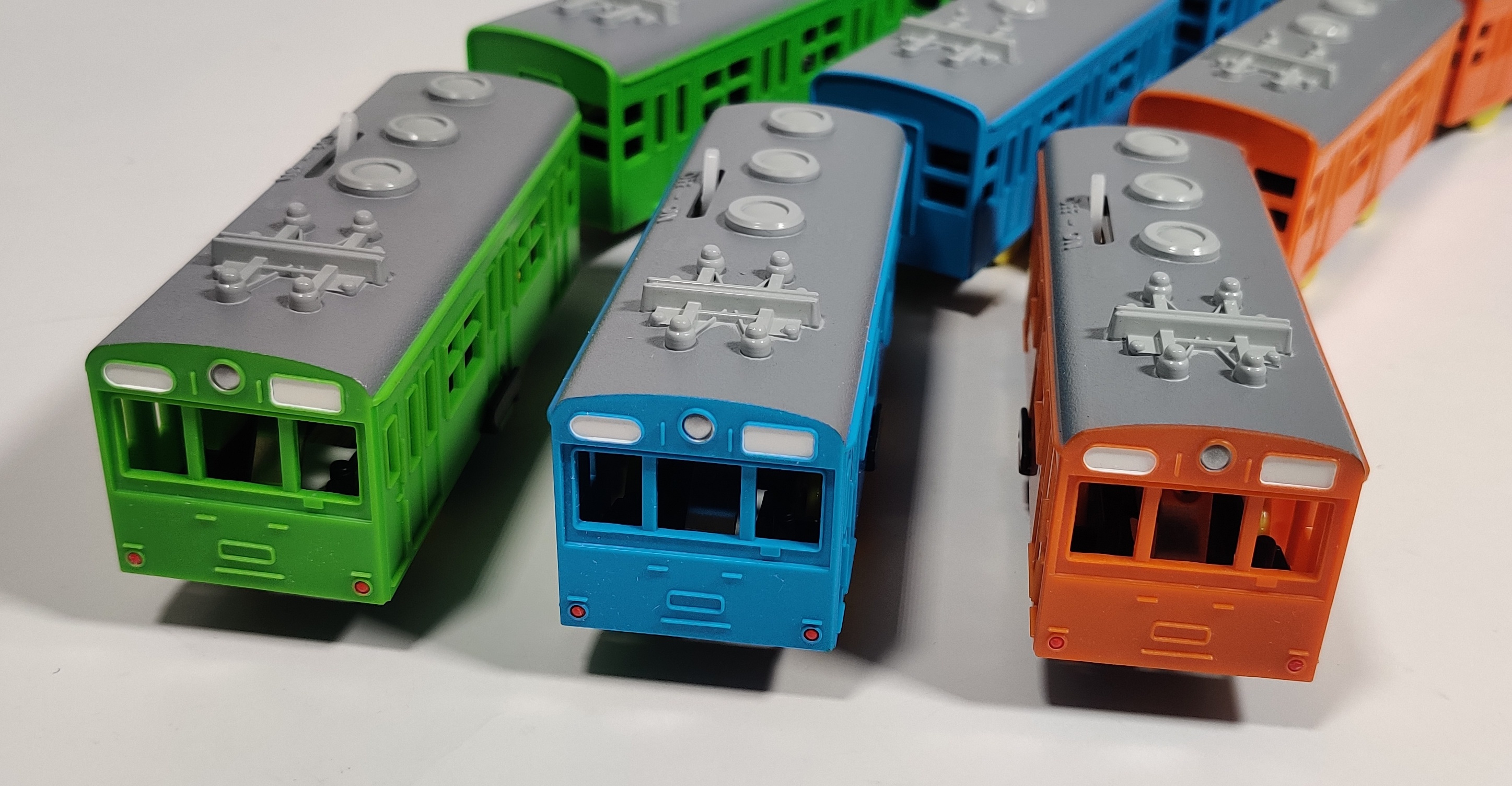
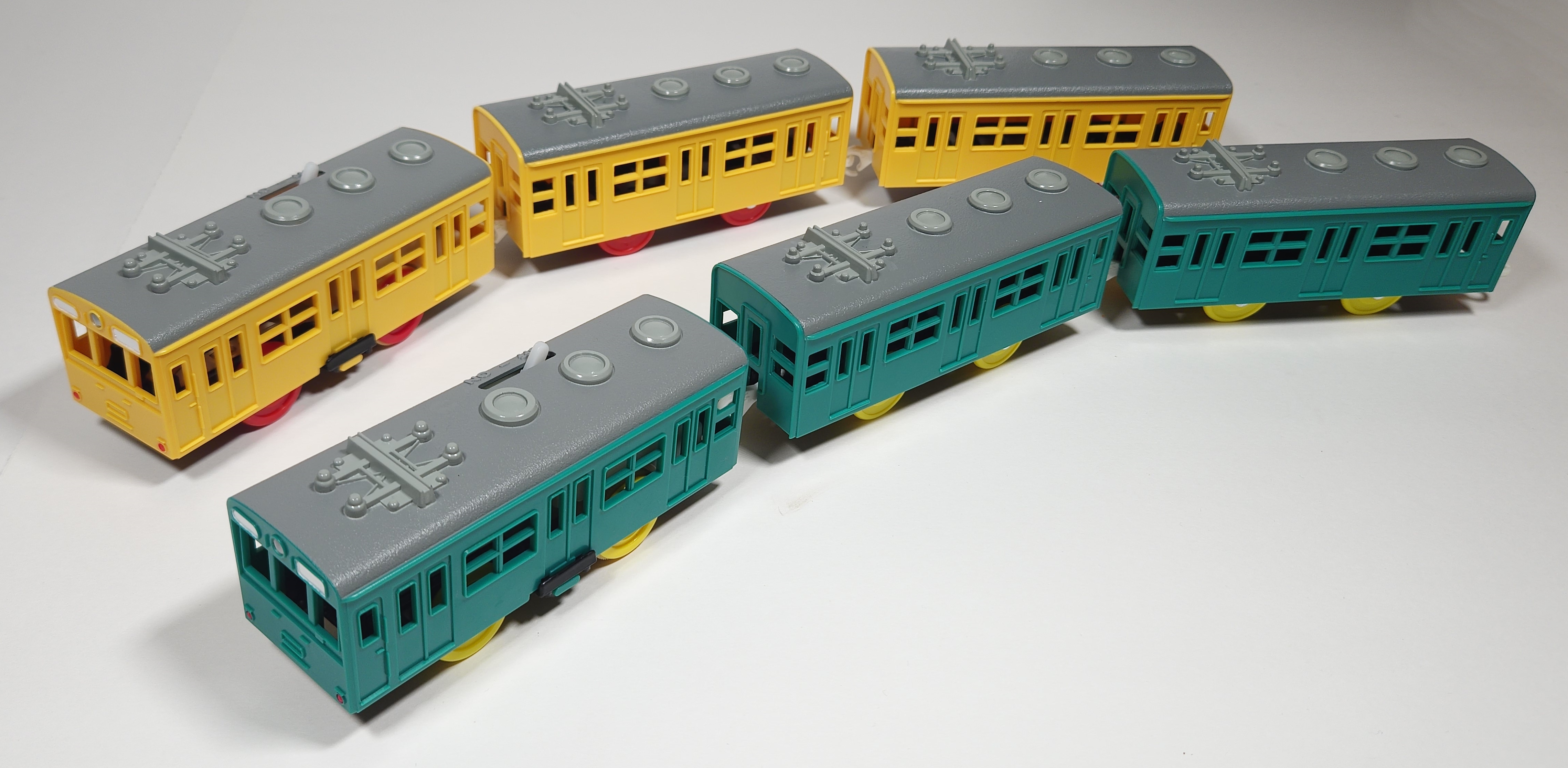
In 1999 as part of the 40th anniversary of Plarail the Yamanote-line green and blue Keihin-Tohoku Trains as well as a properly orange Chuo line train were released as part of the Revival! Electric Plastic Train Trio. Emerald Green and Canary trains were released in 2000 in the Everyone's Choice Revival Trio.
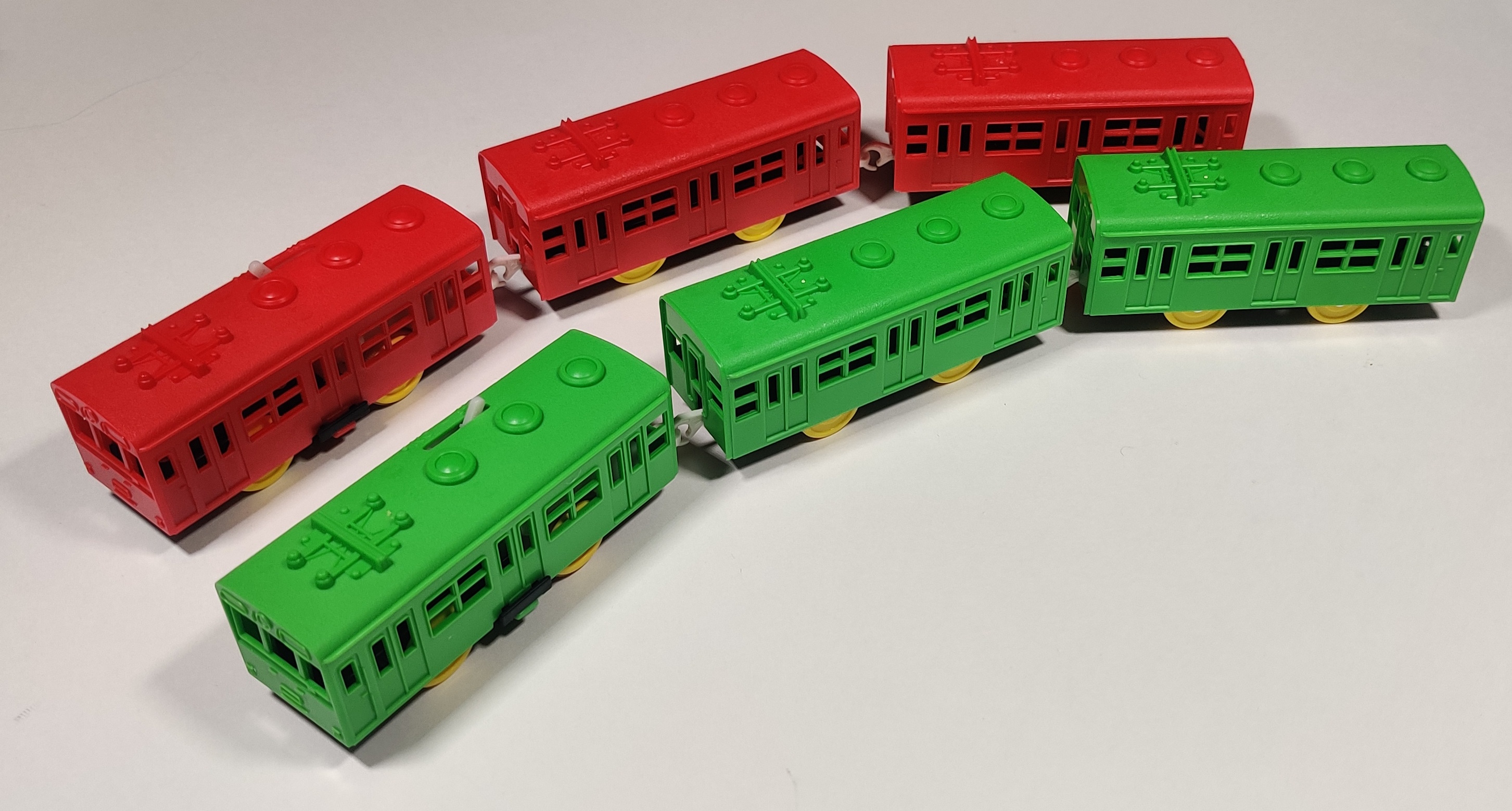
The original unpainted style of green as well as the semi-fictitious red color Electric Trains were reproduced for the early 2005 Plarail 45th Anniversary Set.